Essay
Fractals of Motion in the Work of Václav Bednář
One of the key phenomena of contemporary art is the negation of the boundaries between high art — which makes demands on the viewer’s erudition — and the broader public, whose opinions are shaped above all by stimuli of a consumerist and commercial nature. These aspects have found their application especially in postmodern artistic tendencies founded on a plurality of opinions and formal approaches unbound by any stylistic rules. Globalization and the rapid development of information technology also blur the developmental logic and the uniqueness of national cultures. In the Czech context, painting is now clearly dominated by tendencies based on the principle of veristically conceived stories — a kind of collage of the objective world and fantastical visions of markedly narrative content.
The painter, draughtsman, and designer Václav Bednář (1974) resonates with these aspects above all in his way of perceiving the world as an open, multicultural space. The character of his work, however, has always been shaped first and foremost by the inner experience of a particular phenomenon and by personal experience. He drew and painted from early childhood. In his artistic activity he was strongly supported by his maternal grandfather, a collector of antiques and an ardent lover of art, who recognized Václav’s innate talent and significantly influenced his decision to pursue art professionally. The future painter’s abilities are attested by a surviving series of still lifes inspired by the works of Baroque masters, distinguished by a perceptive feel for pictorial structure and a mature culture of painterly delivery. In adolescence he was actively involved in rock music, which suited his dynamic nature and his urgent need for freedom.
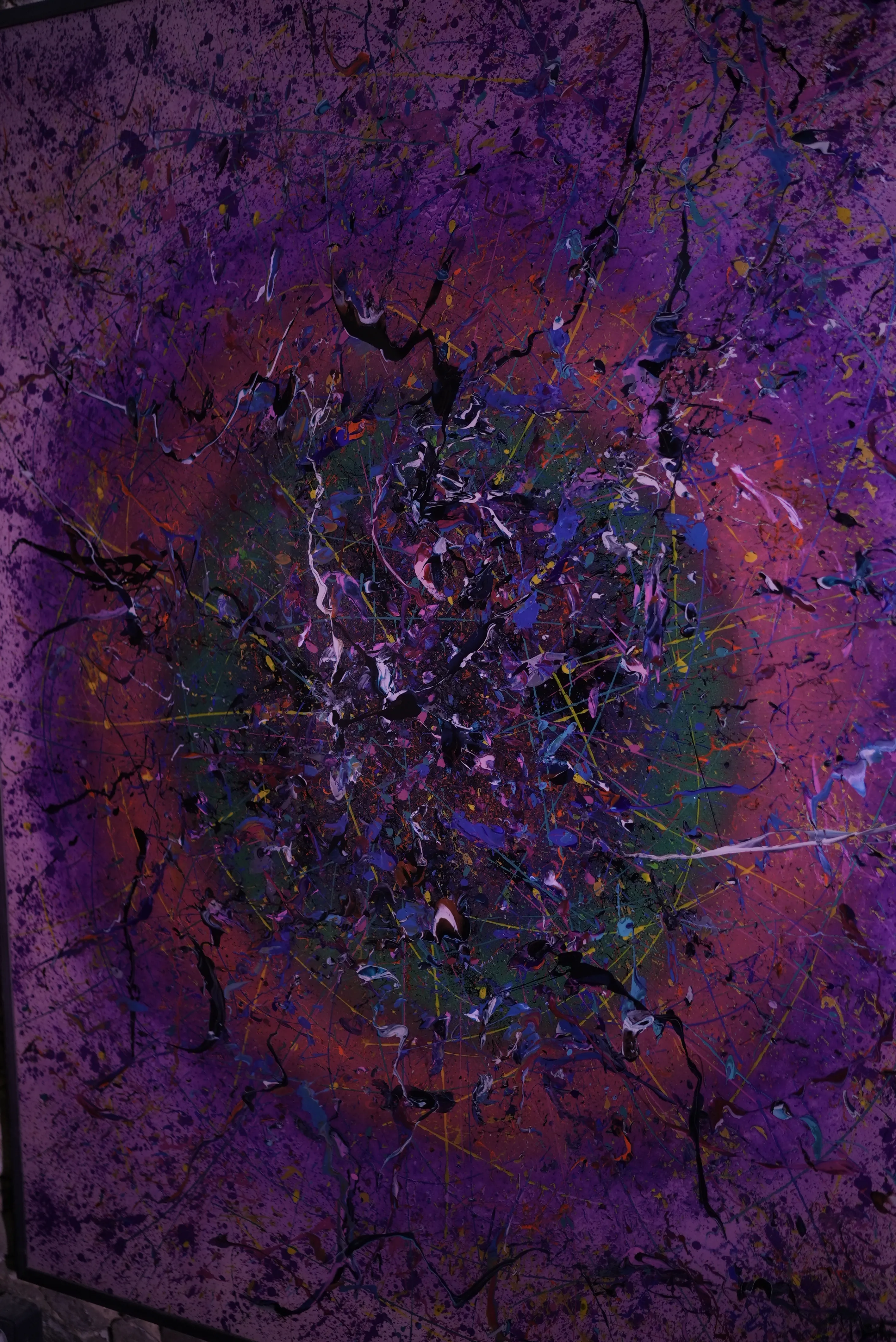
A number of the idols of the rock scene and pop culture of the time also became frequent subjects of his paintings and drawings. The intense experiences of musical performances and of ordinary life situations led him to interpret his psychic and physical states through free painterly form. Alongside the evident formal inspiration of action painting, with its preference for a spontaneous method of execution, Bednář also consciously strives for a marked aesthetic impact in his works. He arrived at painting on tempered glass — for years the hallmark of his expressive and technical originality — by chance, when he was struck by the colored stains on the glass panel of a display case he was using as a palette. He discovered that, on its reverse side, a layer of transparent material multiplied the natural intensity of the color’s optical effect. The planes of tempered glass thus became for him, above all, a vehicle for intensely dynamic records that give material form to his creative energy and evoke a range of reflections of a philosophical and psychological nature.
Another striking feature of Bednář’s mentality, and of his reflection on our globalized, commerce-obsessed present, is his work in clothing design. Hand-painted T-shirts, jackets, and trousers are dispatched in pizza boxes decorated with the same motif. Each of these garments is an original. In this way, over the years, he has connected hundreds of people across the world. He has personally met, on various occasions, many of those who wear his Out of Control brand, which fuses a commercial product with a singular, optimistically playful design.
Václav Bednář is an artist who seeks the meaning of his work neither in sophisticatedly organized allegories nor in the engaged postures of currently fashionable movements. His work is the visual articulation of the painter’s inner energy and of his relationship to the reality in which he lives.
He is a kind of notional fractal — a form of unchanging essence in open space and constant motion.
Interview — OL 4YOU magazine, 2026
Václav Bednář: Abstraction in painting is like jazz in music
A painter who paints on tempered glass "in reverse," who packs hand-painted T-shirts into pizza boxes known all over the world. His paintings hang in private collections from New York to Australia; he paints clothing for The Rolling Stones and for a circle of their die-hard fans. He came to Olomouc by chance. Václav Bednář lives and works on a farmstead near České Budějovice. A conversation with him is exactly what you would expect — unpredictable, candid, and full of stories no one could make up.
Let’s give it a try. When did you first pick up a pencil?
I was drawn to art from early childhood. My grandfather, Václav Busta, owned a collection of antiques, and through him I was surrounded by beautiful things. I admired the old masters and dreamed that one day I, too, would be a painter. My grandfather was always my support, and that strengthened my confidence to follow my own path, even later, when the painter’s profession seemed deeply uncertain. Thanks to that, I bridged the agony of choosing between security and freedom. I realized that anyone who wants unconditional freedom can never have certainty. And the reverse is equally true.
I drew very gladly and often. I thought everyone could do it, that it was nothing special. If you want to paint well, you have to know how to look. :)
And how did you get from drawing to color?
For a long time I thought I would never learn to work with color, because I didn’t know it was a craft — that it can be learned. I wanted to learn the old techniques, so I visited a friend, an illustrator, and showed him my drawings. He told me they were good, explained the basics, and from there I carried on by myself. I have no formal schooling. I’m self-taught.
I worked my way from easier techniques to more difficult ones, until I reached the Baroque still lifes that my grandfather still saw near the end of his life.
But you ended up with abstraction.
For a long time I did abstraction just for myself. I made my living from portraits — mostly portraits of musicians.
I have a lot of musician friends, because I love music. I don’t know that many painters. :)
Most of them — let’s say ninety percent of musicians — go to the orchestra as if to a job, and when they come home they put the instrument in the corner and go off to do their own thing: windsurfing, or working in the garden. But the remaining ten percent come home from work and devote themselves to music there too. They usually still play in several bands at once and compose their own music. And they end up, by way of blues, at jazz. Except those ninety percent of professionals can’t play that jazz with them, because they need sheet music for everything.
And it’s the same with abstraction among painters. Good abstraction is like good jazz. It’s freedom, not the slavish copying of a fleeting reality.
Your main technique is painting on tempered glass. You paint "in reverse" — from one side of the glass, but you look at it from the other. How did you come to that?
I was painting large compositions and large-scale works on walls. The consumption of paint was enormous, and soon no palette was big enough for me. While I was thinking about where to mix the colors, my eye fell on a sheet of tempered glass that slid into a wooden display case a carpenter had made for me years before. I flipped it glass-side up, mounted wheels on the back, and had a large mobile table — an enormous glass palette.
And soon after, I painted the first picture directly onto that glass. I was curious how it looked from the other side, and in that moment the whole thing began. :)
Which painting do people like most, and which would you want to be the most famous? Because those two don’t have to be the same.
People notice most the paintings in public places with open access — at Mánes, at the Národní Café, or here in Olomouc at Envelopa. They often take photos next to them and send the pictures to me.
And the painting I value most? That one I don’t sell. That one I keep at home.
Where else do you exhibit abroad?
In 2024 there was a large exhibition in Saint-Tropez. It was held in the listed monument Lavoir Vasserot on the main square.
In 2025 there was an exhibition in Bratislava, and this year there will be an exhibition in the Myslbek passage in Prague.
This year a gallery is opening in Sydney, where I sent eight paintings in crates to begin with. They all sold before the gallery was even finished, and so I received an offer to work for a while directly in Australia. Now I’m facing a decision: whether to send more paintings, or to fly over and create an Australian collection directly in Sydney, as the gallerist suggests. He knows what’s involved — he collected the crated paintings here in the Czech Republic, even though together they weighed over 300 kilograms. So I’m weighing whether to embark on such a big adventure, because my works are not standard. The frames are welded from iron, the glass must be tempered, and everything has to be made to measure. Here I have everything arranged. So we’ll see how it turns out. :-)
How did you actually end up in Olomouc? That’s quite far from Budějovice.
That’s a story full of coincidences. I drove to Zábřeh to buy something, and the man selling it asked me what I do. I told him I’m a painter. And he says: "Good heavens, my uncle — he’d love to talk with you. Paintings, that’s his whole life!"
I told him that wouldn’t be a problem if his uncle lived in Zábřeh. He called him, and I hear over the phone: "Good heavens, you’ve got a painter there? I’d so love to talk with him — you know paintings are my whole life. But I’m not home, I’m laid up after a stroke in the hospital in Šumperk."
We said goodbye; he gave me his number and I promised I’d call sometime. Except I didn’t. I went to a shop, bought a box of treats, and drove straight to the hospital in Šumperk. I knocked on the room, went in, and asked: "Hello, is one of you Mr. Ivo Balcárek?"
From the corner came: "That’s me! And who are you?"
I say: "I’m the painter your nephew told you about. And because you love art so much, I came to visit you. And here I’ve brought you some treats."
At the time I didn’t yet know he had diabetes, so in the end it was the nurses who did the nibbling. :)
Ivo Balcárek introduced me to Olda Bartoněk, and I decided to hold an exhibition at the château in Hnojice near Olomouc. And that’s how it all began.
And because Olomouc — as my friends here let me know — is one big village, it wasn’t long before I met many wonderful people, many of whom are among my closest friends. I fell in love with Olomouc. I’m very grateful to fate for blowing me here. Olomouc is my second home, and I’ll always be glad to return.
You said it’s hard to do an interview with a painter…
I’m not used to talking. I’m used to expressing myself through a painting. A person’s work should speak for them. With a poet — now that would be an interview. But with a painter?
Where, in your view, is the boundary — in art and in life?
That’s a very complex question, because it has several levels. It depends on the angle from which you look at it. Generally speaking: "Art as such is unequivocally without boundaries, just as life as such is eternal."
But there is also another boundary, far closer to us than infinity and eternity. Let me try to explain. I’m painting a picture and I’m thrilled. I don’t know when to stop, because at such a moment it’s hard to remember that less is sometimes more. If I let myself get too carried away, I can easily ruin the picture.
So the boundary I grapple with day in, day out — one that holds not only in art but in life — lies between this: "How far you can go before you go too far."
And to hit it — that’s the real art.
Further interviews